
Need help deciding on how you will fill up your Pioneer water tank?
When deciding how you will get the rain from your house or sheds roof into your tank, there are 2 primary ways to accomplish this – Wet or Dry, lets have a look at the differences between using a wet or dry system.
If you’d like a full overview of your tank options and configurations, visit our tank information resource centre for detailed guidance.
Dry System
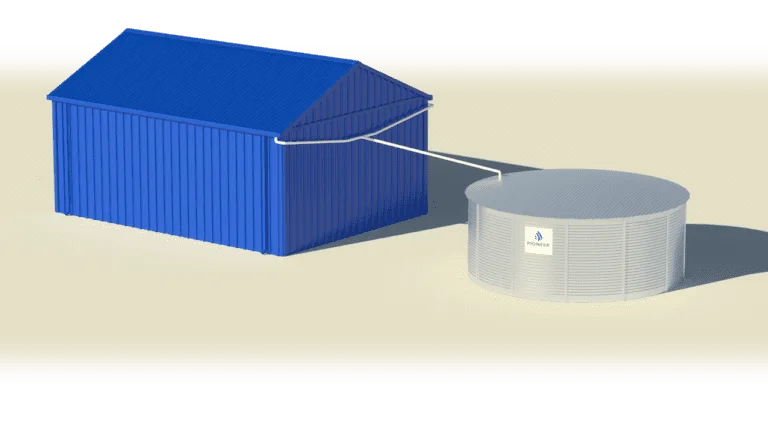
The dry system is certainly the most traditional and recognisable set up, where by the gutter and downpipes come straight from the roof and down into the tank. It is called a dry system because after a rain the pipes are left dry as the water has all ran into the tank. Some benefits and restrictions on this system are:
- Typically the cheapest to set up only needing pipes from your gutter straight to the tank.
- The simplest and cheapest system to set up.
- Best suited to where the tank can be positioned close to the structure collecting rain.
- Limits how far away you can place the tank.
- Can look unsightly with lots of pipes running off your shed to multiple tanks or from multiple gutters.
Wet System –
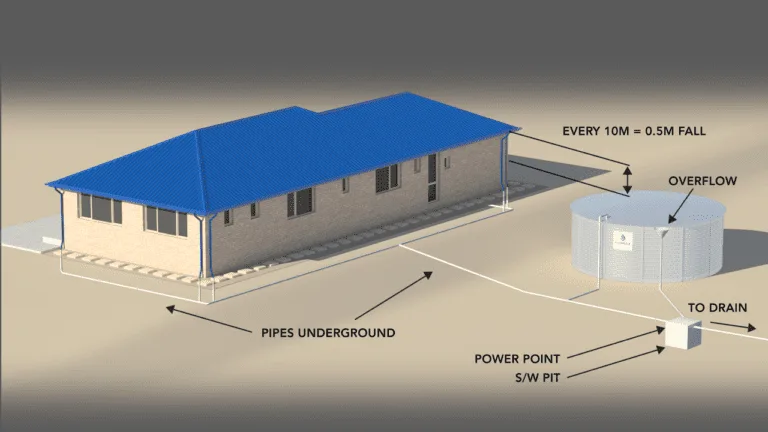
The wet system is where the pipes from your gutters go underground and then travel up the side of your tank into your inlet whether that is a filter basket or wall inlet. It is called a wet system because after a downpour the pipes are left filled with water because there isn’t enough pressure to force it into the tank. This water can be removed via a first flush diverter so that when it rains, you’ll get fresh rainwater going into your new tank.
Because the water needs to go up the side of the tank there does need to be a large height distance between your gutters and the tanks inlet, as a rule of thumb we recommend 500mm for every 10 meters the tank is away from the downpipes.
The benefits of a wet system is it allows your tank to be placed further away from your house or if there is a difficult path for downpipes to travel to the tank. It also gives the house a cleaner look as there isn’t pipes hanging overhead. Because the pipework doesn’t need to be supported as its buried in the ground it can sometimes be easier to design but will initially be more labour intensive as the pipe must be buried and cost more due to the extra labour and extra pipework.
First Flush Diverter
Both wet or dry set ups will greatly benefit from a device known as a first flush diverter. The kits can be readily bought from most hardware and irrigation shops and allow DIY install. We have included below a image to help explain how the system works.
To enhance your setup further, explore our full range of tank accessories and system add-ons designed to improve water quality and performance.

Frequently Asked Questions
1. What is the difference between a wet and dry tank system?
A dry tank system connects gutters directly to the tank using above-ground pipes that drain completely after rainfall. A wet tank system runs underground pipework to the tank, which remains filled with water between rain events. Wet systems allow the tank to be positioned further away, while dry systems are simpler and more cost-effective to install.
2. Which tank system is better for my property?
The best tank system depends on your layout and distance from gutters to the tank. If your tank is close to your home or shed, a dry system is usually the simplest option. If your tank needs to be placed further away or you want a cleaner look without exposed pipes, a wet system may be more suitable.
3. Do I need a first flush diverter for my tank?
Yes, installing a first flush diverter is highly recommended for any tank system. It diverts the initial runoff from your roof, which may contain debris and contaminants, ensuring cleaner rainwater enters your tank and improving overall water quality.
If you would like to find out other reasons what makes a Pioneer Water Tank is so good, please click here.
If you would like a quote on a Pioneer Water Tank, Please request a quote from us today! or call us on 8331 8009.

Recent Comments